Four aggregators account for most Australian brokers: Loan Market Group, Connective, AFG and Finsure. Around them sit two branded franchise networks (Aussie and Mortgage Choice), mid-sized groups such as Specialist Finance Group, outsource Financial, Yellow Brick Road Aggregation and nMB, and a set of boutiques. They differ in how they charge, whose credit licence you work under, the platform they give you, how they pay commission, and what happens to your trail if you leave. Connective, Vision and Yellow Brick Road publish prices. Most others do not. This guide sets out what each one states publicly, with a source for every figure.
What an aggregator does
An aggregator sits between a broking business and the lenders. It holds the lender panel and the accreditations, receives commission from lenders, and pays it on after its fee or split. Most also supply a CRM and lodgement platform, compliance support, training, and authorisation as a credit representative for brokers who do not hold their own Australian credit licence.
The MFAA's State of Mortgage and Finance Broking Report 2026 counted 24,116 brokers in 2025, up 9.1% on the year before. Brokers wrote a record 81.6% of new residential home loans in the June 2026 quarter.
The aggregators side by side
Two broker counts are shown because they measure different things. The first is each company's own figure. The second is the number of credit representatives on ASIC's register at 1 October 2026, as compiled by WealthX. It leaves out brokers who hold their own credit licence, so it understates aggregators with many licence holders. Loan Market Group and Lendi Group have disputed their counts.
| Aggregator | Owner | Brokers, own figure | Credit representatives | Platform | Lenders |
|---|---|---|---|---|---|
| Loan Market Group (LMG) | Family owned | More than 6,000, Australia and New Zealand | 3,765 | MyCRM | More than 100 |
| Connective | Private | More than 5,400 (June 2026) | 3,465 | Mercury Nexus | More than 70 |
| Finsure | MA Financial Group (ASX: MAF) | 3,865 (September 2026) | 2,615 | Infynity, moving to Metanoia | More than 75 |
| AFG | Listed (ASX: AFG) | 4,302 (June 2026) | 2,417 | Suite360 with BrokerEngine Plus | More than 80 |
| Aussie | Lendi Group | 1,312 active (FY25) | 1,175 | In-house platform | More than 25 |
| Mortgage Choice | REA Group (ASX: REA) | 1,140 (June 2026) | 1,138 | Its own broker platform | Not stated |
| Specialist Finance Group (SFG) | Private, family owned | More than 1,200 | 977 | SFGconnect, built on Salestrekker | More than 60 |
| outsource Financial | Independently owned | Not stated | 976 | ioutsource, built by Salestrekker | Not stated |
| Yellow Brick Road Aggregation | Yellow Brick Road Holdings (unlisted) | 1,406 including 126 franchise (FY26) | 932 | VOWNET | Not stated |
| nMB (National Mortgage Brokers) | Liberty Financial | Not stated | Not published | Its own platform, nMB Pro app | Not stated |
| Astute Financial | Private | About 500 across finance, insurance and planning | 368 (July 2026) | Not stated | Not stated |
| Liberty Network Services | Liberty Financial | More than 200 advisers | Not published | Spark+ | 29 shown |
Several names you may know now sit inside larger groups:
- PLAN Australia, Choice and FAST were bought by Loan Market Group from NAB in 2021 and combined into one aggregator, LMG, in 2023.
- Vow Financial was renamed Yellow Brick Road Aggregation from 30 June 2024.
- Smartline is licensed under Mortgage Choice.
- Purple Circle, My Local Broker and Rate Money are grouped under SFG in the WealthX data. Money Quest Group and Buyers Choice are grouped under Loan Market Group.
- Centrepoint Alliance sold its lending aggregation business to Astute Financial in February 2026.
Fees and splits
An aggregator is paid in one of three ways.
- Flat fee. A fixed monthly amount, and you keep all of your upfront and trail. It suits steady volume.
- Percentage split. The aggregator keeps a share of each commission. It costs less at low volume and more as you grow.
- Franchise. You trade under the aggregator's brand and pay for the brand, leads and systems, usually through a lower share of commission.
This is everything we found published. All amounts exclude GST.
| Aggregator | What it publishes |
|---|---|
| Connective, Maximiser | $880 a month for the business, covering up to five brokers. You keep 100% of upfront and trail. No volume requirement. Connective suggests it for businesses settling about $700,000 a month or more. |
| Connective, Variable | You keep 80% of upfront on up to $1 million a month, 85% from $1 million to $2 million, 90% from $2 million to $3 million and 95% above that. You keep 95% of trail. |
| Connective, other fees | $150 a month for each loan writer. Credit representatives pay a further $209 a month each, plus professional indemnity cover on the group policy. Own licence holders pay no licensing fee. No lock-in, and plans can be changed twice a year. |
| Vision Aggregation | Flat fee of $695 a month for an individual or $995 for a group, keeping 100% of upfront and trail. A percentage model paying up to 95%. A mentorship plan at $300 a month, keeping 85%. |
| Yellow Brick Road Aggregation | A percentage model with volume tiers, or a transaction model: $195 for each loan settled and $5.50 for each trail transaction. |
| Loan Market Group | Flat Fee plan (keep 100% of upfront and trail), Partner plan (a revenue share that falls as revenue grows), and the Loan Market plan (revenue share under the consumer brand). No amounts published. No lock-in, and you can change plan once a year. |
| Specialist Finance Group | Four agreements: monthly fee (keep 100% of commission), annual fee paid in advance (keep 100%), a percentage of each settled loan, or a fee per commission payment. No amounts published. |
| AFG | No price list. Its FY26 results show it kept 3.7% of residential upfront and 5.0% of trail across the network, and that the share of trail paid to a broker is set at settlement. |
| Finsure, Mortgage Choice, Aussie, outsource Financial, nMB, Astute | No fees or splits published. |
Prices change. Check each aggregator's own page before you rely on a figure here.
How commission is paid
A lender pays the aggregator, and the aggregator pays the broking business after its fee or split. The MFAA says it can take up to 90 days after settlement for a broker to receive commission. Its 2025 remuneration factsheet puts typical rates at 0.65% to 0.70% upfront and about 0.15% a year in trail, both calculated on the loan balance net of offset.
Lenders set their own timing. Yellow Brick Road's published commission policy gives examples: one lender calculates upfront on the 10th and pays on the 15th of the month after drawdown, and another calculates trail at month end and pays the month after. Rates move too. ING changed to a fixed 0.715% upfront and 0.165% trail from 1 August 2026.
Connective is the only large aggregator that publishes its payment calendar:
- Monthly. Most commission is paid on or around the 24th, with a second batch on the last day of the month.
- Weekly, by choice. Members can opt in to advance payments of upfront commission each Monday, which are deducted from the monthly payment.
- Statements. An RCTI is issued with each payment, and statements can be downloaded from Mercury Nexus as an RCTI summary or a CSV file.
An RCTI is a recipient created tax invoice: the aggregator writes the tax invoice for the commission it is paying you. The rules sit in the ATO's Recipient Created Tax Invoice Determination 2023, which requires both parties to be registered for GST, a written agreement, and the invoice to be issued within 28 days.
Clawback is limited by law. Under the 2020 mortgage broker regulations a lender cannot claw back commission more than two years after settlement, cannot claw back more than it paid, and the cost cannot be passed to the borrower. The MFAA's 2026 report put the median clawback per broker at $11,442 in 2025, up 16.5%.
Each aggregator in detail
Loan Market Group (LMG)
The largest aggregator by credit representatives. LMG describes itself as wholly family owned, with no bank shareholders. Loan Market began in 1994. LMG bought PLAN Australia, Choice and FAST from NAB in 2021 and merged them into one aggregator in 2023. Loan Market continues as the franchise brand. It reported more than $130 billion in settlements and a $370 billion loan book for FY25.
- Models. Flat Fee, Partner and Loan Market plans for residential brokers, with separate commercial and asset finance plans.
- Licensing. Credit representative of LMG, or your own licence. The Loan Market plan is for credit representatives only.
- Platform. MyCRM, built in-house, with a digital fact find, workflows, marketing and commission dashboards.
- Leaving. LMG says the trail book belongs to the broker and leaves with them, on 14 days' notice, with no penalties.
- Recognition. Gold for lending panel in MPA's 2026 survey. Loan Market was MPA's overall winner in 2025.
Connective
Privately owned, founded in 2003 and based in Melbourne. Connective reported $135.47 billion in settlements for calendar 2025 and added more credit representatives in 2026 than any other aggregator in the WealthX data. It publishes more about its terms than anyone else, through a public help wiki.
- Models. Maximiser (flat fee) or Variable (split), set out in the fees table above.
- Licensing. Your own licence at no extra fee, or credit representative status for a monthly fee.
- Platform. Mercury Nexus, included in membership, with lodgement, a client portal, open banking and compliance workflows.
- Commission. Monthly, with optional weekly advances. Connective states that 99.9% of commissions are paid correctly and on time.
- Leaving. Connective says you own your trail book. Resignation takes 30 days' notice. After you leave, Connective keeps paying your trail and charges a commission management fee of 2.4% of monthly trail, capped at $500 a month. It will process a transfer of loans to another aggregator for a fee where the lender approves, and notes that some lenders do not.
- Recognition. Major Aggregator of the Year at the 2026 Australian Broking Awards, and bronze overall in MPA's 2026 survey.
AFG
Australian Finance Group was founded in Perth in 1994 and listed on the ASX in 2015. At 30 June 2026 it had 4,302 brokers, $75 billion in residential settlements for the year and a $231.5 billion residential loan book. It says one in nine Australian mortgages is written by an AFG broker.
- Models. No public price list. See the fees table for what its results disclose.
- Licensing. Your own licence, or credit representative status with AFG managing licensing, complaints and professional indemnity cover.
- Platform. Suite360, including BrokerEngine Plus for workflow and lodgement. AFG owns BrokerEngine.
- Leaving. AFG says moving a trail book to a new aggregator is not generally accepted by lenders or aggregators. It keeps paying trail after a broker leaves if the broker gives 30 days' notice, is not in breach, keeps professional indemnity insurance and pays a monthly management fee.
- Other. AFG Home Loans white label range, a Broker Investments program that takes minority stakes in broking businesses, and loans to brokers secured against trail.
- Recognition. Silver overall in MPA's 2026 survey, with silver for commission accuracy.
Finsure
Established in 2011 and owned by ASX-listed MA Financial Group since 2022. At 30 September 2026 it had 3,865 brokers and $197 billion in managed loans. Broker numbers fell from 4,208 at the end of 2025.
- Models. Not published. Finsure describes its commissions and pricing as flexible.
- Licensing. Credit representative or your own licence.
- Platform. Infynity, which is being replaced in stages by a rebuilt platform, Metanoia, with full migration planned by 2027.
- Commission. Commission Now advances commission from unconditional approval, up to 90 days early, for a monthly factoring rate. Eligibility conditions apply.
- Leaving. Finsure does not publish its trail or exit terms.
- Worth knowing. In April 2026 Finsure ended its agreement with sub-aggregator Hai Money, which had about 211 brokers. If you sit under a sub-aggregator, your position depends on its agreement with the aggregator as well as your own.
Specialist Finance Group (SFG)
A private, family owned aggregator that began in Perth in 1991 and is led by founder William Lockett. It has offices in Perth, Sydney, Melbourne and Brisbane and reports more than 1,200 brokers and more than 60 lenders. It describes its approach as high tech and high touch.
- Models. Four agreements: monthly fee, annual fee, percentage or transaction. Amounts are not published.
- Platform. SFGconnect, an enterprise build of Salestrekker. SFG moved to Salestrekker 2.0 in April 2025 and added AI drafting of compliance and submission notes in November 2025.
- Commission. SFGassist, launched in 2023 with Escientia, gives members itemised payment summaries, book management, fixed-rate expiry alerts and income forecasting.
- Other. Balance sheet finance for members buying trail books, a mentoring partnership with Mr Mentor from June 2026, and a national conference and retreats.
- Leaving. SFG does not publish its trail or exit terms.
outsource Financial
Independently owned, founded in 2010 by Tanya Sale and Andrea Tassis. It was the overall gold medallist among large aggregators in MPA's 2026 survey, including gold for IT and CRM support and bronze for commission accuracy.
- Models. Broker, referrer or a combination. Fees are not published.
- Platform. ioutsource, built by Salestrekker. In July 2026 it moved RCTIs and commission statements to Escientia's ASSIST platform.
- Other. Two years of mentoring for new brokers.
nMB (National Mortgage Brokers)
Founded in 2001 and owned by Liberty Financial since 2017. nMB took gold for accurate, on-time commission payments in MPA's survey in both 2025 and 2026. It does not publish current fees, broker numbers or exit terms.
Yellow Brick Road Aggregation
Formerly Vow Financial, renamed in June 2024. Its parent left the ASX in November 2023 and is now an unlisted public company. For FY26 it reported 1,406 brokers, $30 billion in settlements and an $81.1 billion loan book. Brokers can hold their own licence or be credit representatives. It runs a percentage model or the transaction model in the fees table, and its FY25 accounts show 97% of trail paid through to aggregation brokers on a weighted basis.
Mortgage Choice and Aussie
Both are branded franchise networks, so the comparison is different: you trade under their name and receive leads in return for a lower share of commission.
- Mortgage Choice is owned by REA Group. For FY26 it reported 1,140 brokers, $27 billion in settlements and a $95.6 billion loan book. Brokers receive leads from realestate.com.au. Franchise fees and payout rates are not published.
- Aussie is Lendi Group's main broking brand, with 1,312 active brokers and $28 billion settled in FY25. It offers salaried, mobile and franchise roles. In July 2026 it proposed a model called Aussie Modular, with up to 90% of trail passed through on business a broker generates themselves. That proposal was still in consultation when reported.
Boutique and specialist aggregators
- Money Quest Group. Launched in 2007 and based in Melbourne, with franchise, revenue share and flat fee models. It uses LMG's MyCRM. It won gold in all 11 categories of the boutique tier in MPA's 2026 survey.
- Purple Circle. Broker owned, founded in 2016, with flat fee, percentage or hybrid models for licence holders and credit representatives. Members earn shares. MFAA Boutique Aggregator of the Year 2026.
- Liberty Network Services. A Liberty Financial business founded in 2011, with more than 200 advisers on its own Spark+ platform.
- Astute Financial. Privately owned, operating since 2000 from Queensland, across finance, insurance and planning. It took over Centrepoint Alliance's lending aggregation business in 2026.
- Vision Aggregation. A boutique that publishes its prices, shown in the fees table, and uses the Infynity CRM.
- My Local Broker. Launched in 2017 in Victoria, with more than 130 brokers and more than 60 lenders.
How brokers rate them
Mortgage Professional Australia surveys brokers each year. More than 720 took part in 2026. Commission accuracy was the most important factor, ahead of lending panel and IT and CRM support, and it has held that place for five years. Asked what would make them leave, 60% of brokers named poor commission accuracy, 54% poor IT and CRM support and 51% poor BDM support.
| 2026, aggregators with more than 600 brokers | Gold | Silver | Bronze |
|---|---|---|---|
| Overall | outsource Financial | AFG | Connective |
| Commission accuracy | nMB | AFG | outsource Financial |
| IT and CRM support | outsource Financial | AFG | Connective |
| Lending panel | Loan Market | outsource Financial | AFG |
In the boutique tier, Money Quest Group took gold overall, Purple Circle silver and Liberty Network Services bronze. A survey reflects the brokers who answered it, so treat it as one input.
Changing aggregator
Few brokers move. In MPA's 2026 survey 74.75% said they were extremely unlikely to switch, down from 81% in 2023. The reason is practical: a move interrupts lender access and raises the question of what happens to trail.
What happens to your trail
- Existing loans usually stay where they settled. Macquarie tells brokers it keeps paying trail to the aggregator a loan was settled under, and that it cannot move existing loans to a new aggregator. Connective notes that several lenders do not approve transfers to another aggregator.
- Your old aggregator normally keeps paying you, on conditions. AFG requires notice, no breach, continued professional indemnity cover and a monthly management fee. Connective charges a commission management fee on trail it continues to pay. Loan Market Group says the trail book leaves with the broker.
- Your agreement decides. Finsure, SFG, Mortgage Choice and most smaller aggregators do not publish their terms, so the answer is in the contract you signed.
The practical result is that after a move you are usually paid by two aggregators for years: the old one for loans already settled, and the new one for everything after.
What a move involves
- Read your agreement first. Check the notice period, which is often 30 days, the conditions on trail, any exit or ongoing fees, and what data you are entitled to take.
- Arrange your authorisation. If you are a credit representative, your new aggregator has to appoint you. Do not act as a broker in any gap between authorisations.
- Re-accredit with lenders. AFG has said most lenders require an accreditation transfer, that it can take several weeks, and that many lenders suspend access while it is processed. The MFAA has published a single transfer form that several lenders accept. Not all do.
- Agree a cut-over date. Applications already formally approved generally settle through the old aggregator. Others may need to be lodged again.
- Move your client records. Brokers who have switched report that file notes and attachments often do not carry across between CRMs.
Timing varies. An MFAA working group reported six to eight weeks as typical in 2024, some brokers report two to three months for individual lenders, and SFG has said a well planned move can be done in days. Reference checks between aggregators are now governed by an ASIC protocol, mandatory from 1 March 2025, with a response due within 10 business days.
What to ask before you sign
- What will I pay in total at my volume? Ask for every fee: membership, each loan writer, licensing, professional indemnity, software and marketing. Then ask for the same figure at double your volume.
- What happens to trail on loans already settled if I leave? Ask for the clause, the conditions, and any management fee.
- What is the notice period, and are there exit fees?
- Whose credit licence will I work under?
- How often is commission paid, and in what form do statements arrive? Ask for a sample statement, and how errors and missing payments are raised and fixed.
- What moves across from my current CRM, and what does not?
- If I join through a sub-aggregator or group, who is my agreement with?
Keep your own commission record
Commission accuracy is what brokers value most in an aggregator, and the only way to know whether you are being paid correctly is to check it yourself.
- Save every commission statement and RCTI as it arrives, for every commission run. Do not rely on being able to download them later.
- Keep a loan list with the lender, loan reference, settlement date and the aggregator each loan settled under.
- After a move, reconcile both sets of statements. Trail from the old aggregator is the easiest income to stop watching, and a loan that drops off there is still a client who may have refinanced.
The method is in our guide to reconciling aggregator RCTI commission statements.
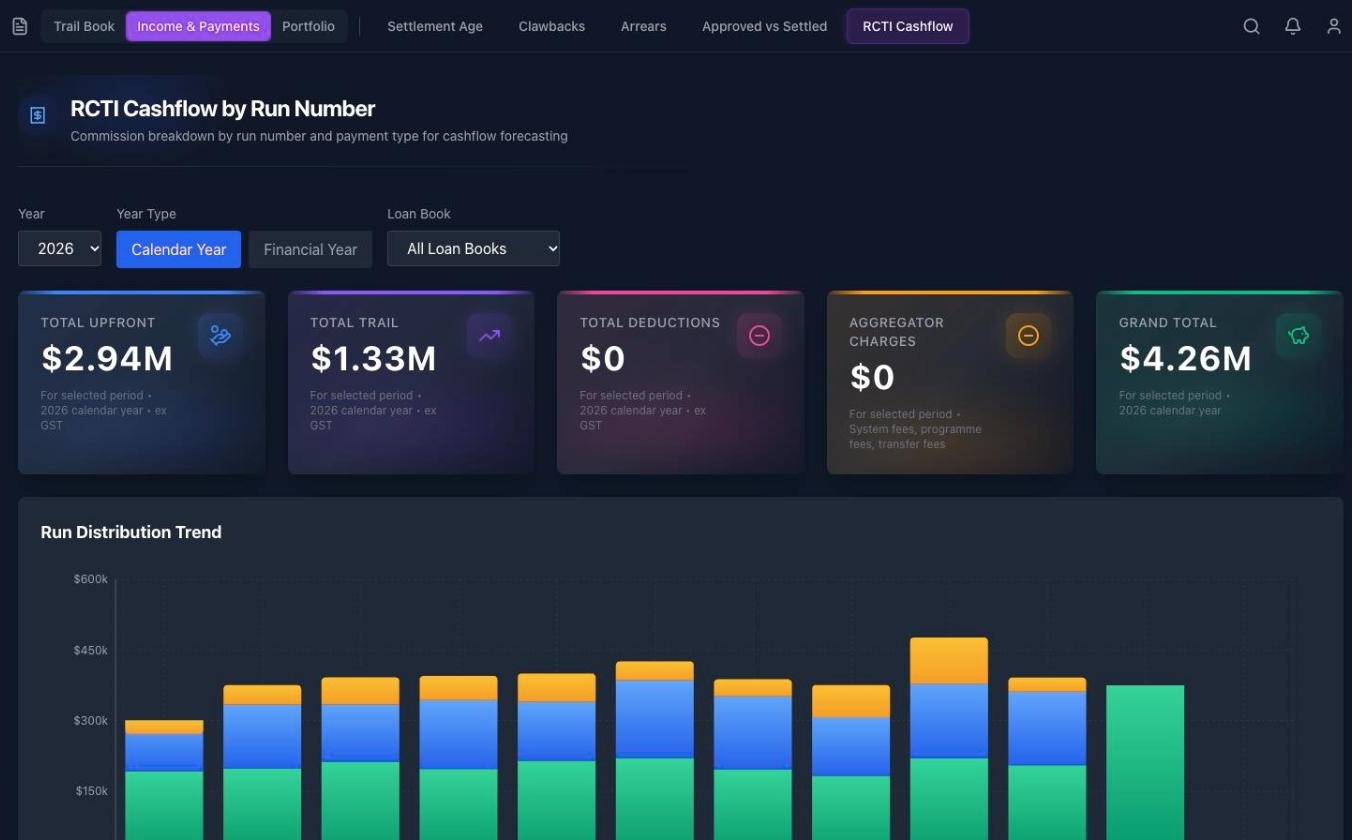
Commission runs broken out by payment type. Demo workspace with sample data.
Where VALUTTEN fits
An aggregator reports what it paid you. VALUTTEN is independent of the aggregator and checks it, loan by loan. It reads the commission statements your aggregator already sends you and places every payment on its loan.
- It works with any aggregator. Statement formats already mapped include Loan Market Group, AFG, Finsure, SFG, nMB and Connective. Coming from another aggregator, your statement format is mapped during onboarding from a sample file.
- More than one aggregator can run in one workspace. Offices or loan books under different aggregators sit side by side.
- Your history stays when you change aggregator. Nothing already loaded is removed. The new aggregator is set up as its own loan book beside the old one, so trail from both is in one place. Because aggregators identify loans differently, a loan that moves to the new aggregator appears as a new record.
VALUTTEN has no connection to any aggregator's commission system. Loan Market Group businesses can choose to connect MyCRM. VALUTTEN is not an aggregator, holds no credit licence and never receives or pays commission.
Check what your aggregator paid, loan by loan.
See how commission is reconciled by month, office and commission run.
More guides
- How to reconcile aggregator RCTI commission statements
- How a mortgage broker trail book is valued in Australia
- How to find clients who have refinanced away
- Spreadsheets or software for commission reconciliation
Sources
All pages were read on 27 November 2026.
- Market: MFAA figures as reported by The Adviser, 28 September 2026 and Broker Daily, 3 September 2026. MFAA, Broker Remuneration Factsheet, 6 March 2025.
- Credit representative counts: WealthX, credit representative report, 1 October 2026. The Adviser, "Brokers flock to Connective as Finsure and Lendi retreat", 8 October 2026.
- Loan Market Group: plans and pricing, about and technology. The Adviser, "Loan Market Group to operate as one aggregator", 10 February 2023. Australian Broker, 30 June 2026.
- Connective: pricing, fees, and its help wiki on commission plans, fees, payment dates, advance payments, commission statements, commission management and trail book transfers. The Adviser, 2 April 2026.
- AFG: FY26 annual report and FY26 results presentation, 20 August 2026. AFG, switching mortgage aggregators, compliance and BrokerEngine Plus.
- Finsure: home page, Commission Now and compliance. The Adviser, 22 October 2026 and 30 April 2026. Broker Daily, 24 March 2026.
- Specialist Finance Group: website. The Adviser, 16 April 2025, 19 November 2025 and 15 June 2026. MPA, 23 September 2023, 29 March 2022 and 13 March 2026.
- outsource Financial: who we are and business models. Broker Daily, 13 July 2026.
- nMB and Liberty Network Services: MPA, nMB company profile. Liberty, Liberty Network Services.
- Yellow Brick Road: aggregation, commission policy, 3 July 2024 and FY25 financial statements. The Adviser, 9 November 2026 and 24 June 2024.
- Mortgage Choice and Aussie: Broker Daily, 7 August 2026. The Adviser, 9 February 2026, 14 March 2025 and 10 July 2026. Aussie, become a franchisee.
- Boutiques: Money Quest Group, Purple Circle, Astute Financial, Vision Aggregation and My Local Broker. Australian Broker, 19 November 2026. The Adviser, 17 February 2026 and 11 December 2025.
- Broker ratings: Mortgage Professional Australia, "2026 Brokers on Aggregators" and 2025 edition. Broker Daily, 28 August 2026.
- Changing aggregator: Macquarie Broker Help Centre, "Understanding broker commission payments". Broker Daily, 8 May 2025 and 30 April 2025. The Adviser, 12 April 2024 and 19 August 2024. MFAA, Lender Accreditation Transfer Form.
- Law and rates: Recipient Created Tax Invoice Determination 2023. Explanatory Statement, mortgage broker regulations 2020. ING, 24 July 2026.
This guide is general information. It is not financial, tax or legal advice. Aggregator fees, plans, broker numbers and agreement terms change and differ between businesses, so check each aggregator's own material and your own agreement before acting. Company and product names belong to their owners. If something here is out of date, tell us at hello@valutten.com and we will correct it.