A trail book is usually valued as its annual trail income multiplied by a multiple. In January 2026, trail book lender TrailBlazer Finance put the median valuation multiple at 2.39 times annual trail, with buyers paying close to three times on average. Where a book lands depends on its quality: loan age, run-off, clawbacks and lender spread.
The method
Take the trail your book earns in a year and multiply it by a number that reflects how reliable that income is.
A book earning $200,000 a year in trail, valued at 2.39 times, is worth about $478,000. The same book at 1.92 times is worth $384,000, and at 2.77 times, $554,000. The income is identical. The multiple carries the difference.
A valuation and a sale price are different things. A valuation is an assessment of fair value. A sale price is what a buyer agrees to pay, and it moves with demand.
What multiples are being paid
These figures come from TrailBlazer Finance, as reported in the trade press. TrailBlazer lends against and brokers trail books, so treat them as one informed source with an interest in the market.
| Measure | Figure | Reported |
|---|---|---|
| Median valuation multiple | 2.39 times annual trail, up from 2.3 times in FY2024 | MPA, January 2026 |
| Range of valuation multiples, FY25 | 1.92 to 2.77 times | The Adviser, August 2025 |
| Average sale multiple, FY2024-25 | Three times annualised trail, up from 2.83 times | The Adviser, August 2025 |
| Bids per book listed | Six on average | The Adviser, August 2025 |
Sale prices have been running ahead of valuations because several buyers are competing for each book.
What moves the multiple
| Factor | Why it matters | Reported benchmark |
|---|---|---|
| Loan age | Loans in their first two years carry the highest refinance and clawback risk | 24 to 60 months described as the best range |
| Run-off | The share of the book that pays down or leaves each year. At about 25% a year, only half the trail remains after three years | Above 25.5% in FY2024, below 23% in 2025 |
| Clawbacks | A high clawback rate tells a buyer that clients are leaving early | 5% or less is healthy, above 15% is not |
| Lender spread | A book concentrated in one lender is exposed to that lender's policy and pricing | No figure reported |
| Arrears | Lenders can stop trail on loans in arrears | No figure reported |
Work out your own number
- Annualise your trail. Add up the last 12 months of trail actually received, from your commission statements. Do not use an estimate from loan balances.
- Measure your run-off. Compare the loan balances paying trail a year ago with the same loans today.
- Measure your clawbacks. Total the clawbacks for the year and note which loans and brokers they came from.
- Look at loan age and lender spread. Note how much of your trail comes from loans under two years old, and how much from your largest lender.
- Apply a range, not a single number. Value the book at a low, middle and high multiple, and be honest about which end your run-off and clawbacks point to.
For a sale, a loan or a dispute, get a formal valuation from a qualified valuer.
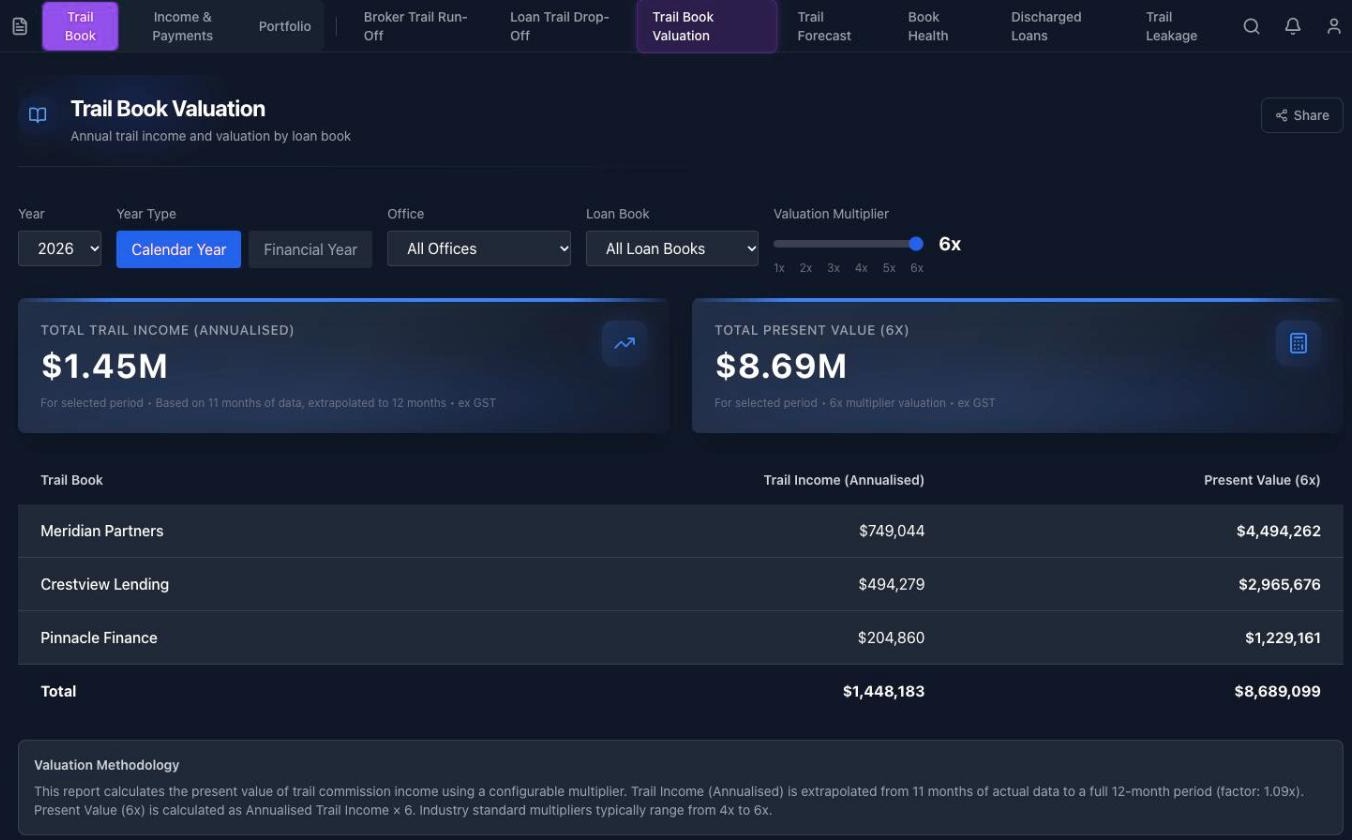
Annualised trail and indicative value by loan book. Demo workspace with sample data.
What you can improve
- Retention. Call clients when their trail drops, before the loan is gone. Run-off is the largest single drag on value.
- Clawbacks. Know which loans are still inside a clawback period and stay close to those clients.
- Records. A buyer pays more for a book they can verify. Loan-level history of what was paid, month by month, is the evidence.
How VALUTTEN shows it
VALUTTEN annualises your trail income from the statements your aggregator sends and multiplies it by the multiple you choose, from 2x to 6x, for each loan book. You can view it by office, by loan book, and by calendar or financial year. The figure is indicative. It is not a formal valuation or financial advice.
See what your trail book is worth.
The trail book valuation page shows the valuation, forecast and book health reports.
More guides
- Mortgage aggregators in Australia compared
- How to reconcile aggregator RCTI commission statements
- How to find clients who have refinanced away
- Spreadsheets or software for commission reconciliation
Sources
- Mortgage Professional Australia, "Inside the trail book bull market", 16 January 2026, reporting TrailBlazer Finance data.
- The Adviser, "Trail book values rise as buyer demand increases", 21 August 2025, reporting TrailBlazer Finance data.
- Macquarie Broker Help Centre, "Understanding broker commission payments", read 26 November 2026. One lender's policy, used as an example.
This guide is general information. It is not financial, tax or legal advice. Commission terms differ between lenders and aggregators, so check your own agreements.