Your commission statements already tell you. A loan whose trail falls to zero has usually been discharged or refinanced, and a loan whose trail drops sharply is often on its way. Compare every loan's trail with the month before, sort the drops by cause, and call the clients you can still keep first.
Why you find out late
Nobody tells a broker when a client refinances elsewhere. The lender stops paying trail, the line disappears from the next statement, and unless someone compares this month with last month, it goes unnoticed.
The scale is not small. TrailBlazer Finance reported that around a quarter of all loans switched lender in FY2024, with run-off easing to below 23% in 2025.
The four signals
| Signal in the statement | What it usually means | Can you still act? |
|---|---|---|
| Trail drops sharply but is still paid | A large repayment, a partial discharge, or a growing offset balance | Yes. The loan is still yours |
| Trail goes to zero | Discharge or refinance. Sometimes a balance under the lender's minimum, arrears, or a late payment | Sometimes. Confirm next month, then call |
| No trail for two months or more | The loan has probably been refinanced or paid out. Check its status before you assume so | For the next loan, yes |
| A clawback appears | The loan was discharged inside the lender's clawback period | The loan has gone. The relationship may not have |
Zero trail is not always a lost client. Macquarie, for example, states that trail may stop when a loan is discharged, when the principal falls below $10,000, or when the loan is more than 60 days in arrears. Each of those calls for a different conversation.
Find them in five steps
- Line up two months of trail by loan. Use the lender account number as the key.
- Calculate the change for every loan. In dollars and as a percentage.
- Pull out three groups. Trail that went to zero, trail that fell by more than half, and loans with no trail for two months or more.
- Add what you need to make the call. Client, lender, broker, and the monthly trail involved.
- Hand each broker their list. A list nobody owns does not get called.
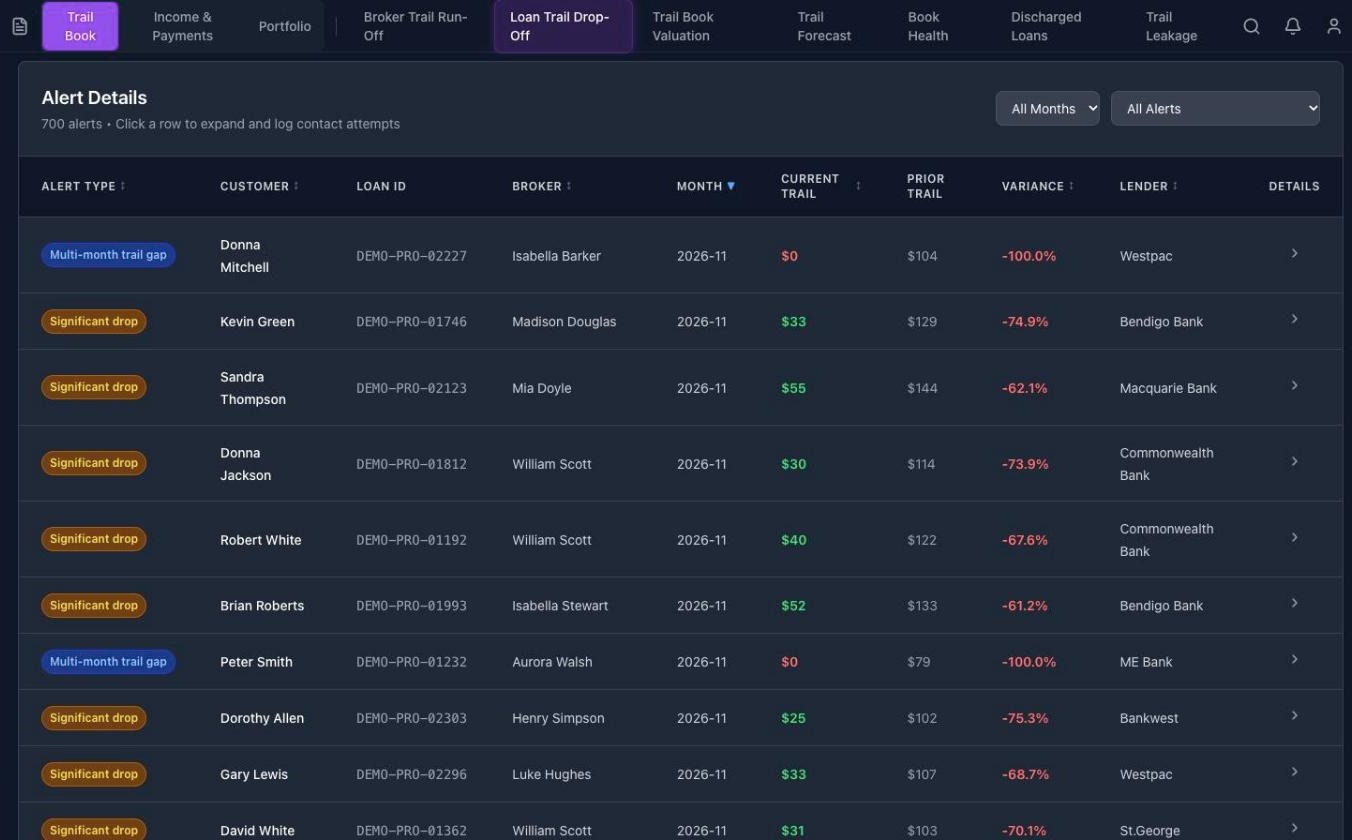
Every drop, loan by loan. Demo workspace with sample data.
Who to call first
- Sharp drops that are still paying. These clients have not left. A review now can keep the loan.
- Trail that went to zero this month. The decision is recent and the client remembers why.
- Larger loans before smaller ones. Rank each group by monthly trail.
- Loans gone for two months or more. Call to keep the relationship and the next loan.
What to record
Write down who called, when, and why the client left: rate, service, sold the property, paid the loan out, or moved to another broker. After a few months the reasons form a pattern, and the pattern tells you what to fix.
How VALUTTEN does it
VALUTTEN sets this month's trail against last month's for every loan and flags the ones that dropped or stopped. Who To Call opens on the dashboard: loans whose trail went to zero come first, then clients with no trail for two months or more, each with the client, lender, broker and monthly trail involved. Open an alert to log the contact attempt, and the history stays with the client. Discharged loans are counted and valued, and you can categorise why each client left.
Know who to call while the client is still yours.
The trail drop-offs page shows Who To Call, the drop-off report, contact history and discharges.
More guides
- Mortgage aggregators in Australia compared
- How to reconcile aggregator RCTI commission statements
- How a mortgage broker trail book is valued in Australia
- Spreadsheets or software for commission reconciliation
Sources
- Mortgage Professional Australia, "Inside the trail book bull market", 16 January 2026, reporting TrailBlazer Finance data.
- Macquarie Broker Help Centre, "Understanding broker commission payments", read 26 November 2026. One lender's policy, used as an example.
This guide is general information. It is not financial, tax or legal advice. Commission terms differ between lenders and aggregators, so check your own agreements.